Speculative Decoding in SGLang(EAGLE2)
约 5603 个字 239 行代码 22 张图片 预计阅读时间 31 分钟
在正式进入 SGLang 源码前,我们需要知道为什么我们需要 speculative decoding 以及什么是 speculative decoding。有了这些认识后,我们可以深入源码来了解 SGLang 是如何将 speculative decoding 与 scheduler 集成起来的
这里先大概给一下 speculative decoding 的示意图

Speculative Decoding Motivation
基于以下观察,提出了 speculative decoding,利用空闲计算资源增加并行性
- Many easy tokens can be predicted with less computational overhead(using a smaller model)
- LLM 推理是高度 memory-bound 的,延迟主要在读取/写入模型参数而不是计算
每次生成一个 token,都需要搬运所有模型权重从 HBM 到 cache 中
我们需要保证 speculative decoding 生成多个 token 的成本要比 auto-regressive 生成 1 个 token 成本差不多,所以投机采样要想获得性能收益,核心要解决以下两个问题:
在整个投机采样的流程中,假设轻量 LLM 生成 Draft Tokens 的开销为 \(p\) ,原始 LLM 验证 & Next Token 生成的开销近似为 1 ,那么投机采样在接受 Tokens 数大于 \(1 + p\) 的情况下才有性能收益,并且随着接受的 Tokens 数增加而性能收益越大。
- 如何降低投机采样的 overhead?
- 如何提升 Verify 阶段的接受率?
What is Speculative Decoding(Original)
一般遵循以下流程:
- Draft: 生成 k 个 candidate tokens,保存了概率分布,即 logits
- Verify:
- 用 target model 并行 verify all candidate tokens
- 对每个位置的分布计算概率
- Accept / Reject:
- 接受所有 correct token
- 在第一个被拒绝采样的位置,在调整后的分布中重新采样
Important
虽然引入了小模型,但最终生成的文本分布(Distribution)在数学上严格等同于大模型独自生成的分布。 它是无损的(Lossless)
Why lossless?
基于拒绝采样的变体:
- \(M_p\):大模型(Target Model),概率分布为 \(p(x)\)。
- \(M_q\):小模型(Draft Model),概率分布为 \(q(x)\)。
对于小模型生成的每一个 token \(x\),我们需要根据大模型的判定来决定是否接受。
- 情况 A:大模型觉得小模型的猜测很靠谱
- 如果 \(p(x) \ge q(x)\)(即大模型认为该词出现的概率比小模型预测的还要高或相等)
- 操作: 直接接受该 token。
- 数学含义: 这种情况下,接受率为 1。
- 情况 B:大模型觉得小模型在瞎猜
- 如果 \(p(x) < q(x)\)(即大模型认为该词出现的概率低于小模型预测的):
- 操作: 以概率 \(\alpha = \frac{p(x)}{q(x)}\) 接受该 token。如果不接受,则拒绝该 token 及其之后生成的所有草稿。
- 修正(Resampling): 一旦拒绝,我们需要重新生成这一个 token。为了保证分布一致性,我们需要从修正后的分布 \(p'(x)\) 中采样:
$\(p'(x) = \text{norm}(\max(0, p(x) - q(x)))\)$ - 这确保了虽然我们拒绝了错误的草稿,但补充回来的 token 能够填补概率分布的缺口,使得总体分布回归到 \(p(x)\)。

Some Limitations
我们需要让 Draft Model 的生成的目标分布与 Target Model 相同,这里有多种选择方式
- 选取与 target model 同一 family 的较小的模型
- Distill 一个轻量模型,teacher 选取 target model,这会引入 training cost
- 选取 ngram 模型,但是这个的接受率很低
Draft model 和 target model 需要共享 vocabulary 或者使用相同的 tokenizer
- \(p(x)\) 和 \(q(x)\) 必须定义在同一个样本空间上
发展历程
Speculative Decoding (Leviathan et al., 2023, Google)
📄 Fast Inference from Transformers via Speculative Decoding
- 首次提出该方法,思路:
- 用一个小模型(draft model)生成多个候选 token;
- 用大模型(target model)验证其中的一部分;
-
若验证通过,则一次提交多个 token,减少大模型调用次数。
-
用更高效的模型 \(M_q\) 生成 γ 个候选 token;
- 然后使用目标模型 \(M_p\) 并行 Verify 这些候选样本及其在 \(M_q\) 中的概率, 并接受所有能使分布与 \(M_p\) 一致的候选;
决定被接受的数量 n(用随机数进行拒绝采样)
- 接受所有正确的采样
- 对第一个被拒绝的候选,从一个调整后的分布中重新采样
如果草稿模型 \(M_q\) 在第 n+1 个 token 被拒绝,那么目标模型 \(M_p\) 不能直接用自己的分布采样,而必须把已经被 \(M_q\) 尝试但拒绝掉的概率质量 \(M_p\) 中减掉,再重新归一化
- 如果所有候选都被接受,只接受 γ-1 个,然后再采样一个额外的 token修正的拒绝采样方案可以保持与 target 采样相同的目标分布
- Limitations
- 使用 separate 的 draft model
- Draft model 训练后效果比较好,引入了训练成本
- Draft model 和 target model 之间的 distribution shift
- Memory overhead of second model
- 每次迭代只有一个 draft sequence
- \(\gamma\)是固定的,简单的 token 会浪费资源,复杂的 token 需要更多的推测
Medusa(No need for a separate draft model)
📄 MEDUSA: Simple LLM Inference Acceleration Framework with Multiple Decoding Heads
- 不是单独的小模型,而是 在大模型 decoder 的 last hidden states 上直接加多个预测头(1-2 layer mlp);
- 每个 head 会为它负责的位置生成多个最可能的预测
- 第 t 个 position 位置处,第 k 个 head 预测 t+k+1 个 token
- 这会增加一次 decoding step 的接受长度
- Verification can be computationally intensive for a large number of completions
We need trade-off
- 为了加速与计算代价之间取得平衡,引入了一种 树状结构的注意力机制(tree-structured attention),可以并行处理多个候选序列,一次验证一整棵树
- 依据预测的 probs 构造了一个稀疏的 candidate tokens 树
- Tree Mask:每个 token 只能看到来自同一条候选序列(continuation)的历史 token,不能访问其他候选的 token。
- 按照树结构,正确分配 positional encoding
同一深度的 token 用同一个 position id
- 会选择长度最长的前缀 candidate tokens


- Limitations:
-
Position-Independent Prediction / Limited Information
- 每个 Medusa head 预测位置 i+k,但它不知道位置\(i+1\dots i+k-1\) 实际预测了什么
与真实的自回归不同
- Medusa head 只能看到最后一层的表示
- 最后一层是为预测下一个 token 训练的,而不是第 2、3 个之后的 token
- 无法利用中间层更丰富的表示
-
Lower acceptance rates for later positions in the draft
- Speedup plateaus at ~3× even with more heads
Lookahead Decoding
📄 Lookahead: An Inference Acceleration Framework for Large Language Model with Lossles

- 层次化多分支草稿策略 (Hierarchical Multi-Branch Draft Strategy):利用共同的前缀标记将多个预测的草稿序列(分支)进行合并和压缩
- 基于 Trie 树的草稿检索和管理 (Trie-tree-based Retrieval and Management)
- Trie 树存储了输入提示 (Prompt) 和已生成响应 (Generated response) 中出现的 n-gram 标记序列(即分支)。
- 引入了 生成分支插入 (Generated branch Inserting) 机制,能够动态地 (on-the-fly) 将生成的重复序列放入 Trie 树中,从而利用输出中的重复模式进行加速。
- 通过分支消除和节点修剪策略来保持 Trie 树的高效性,控制内存消耗。
EAGLE-1: Extrapolation Algorithm for Greater Language-model Efficiency
📄 EAGLE: Speculative Sampling Requires Rethinking Feature Uncertainty
- Train a lightweight plugin, called AutoRegression Head, in conjunction with the Original LLM's frozen embedding layer, to predict the next feature based on the current feature sequence form the second-top-layer of the Original model
- Decode using the frozen classification head of the Original LLM, which maps features to tokens
- Feed in tokens from one time step ahead

EAGLE-1 Drafting
EAGLE-1 解决了 Medusa 的不确定性,使用了 feature-level 进行预测
- Feature prediction with known context is much more accurate
- EAGLE integrates embeddings and generates the next feature
- When predicting \(f_j\), we already know \(f_{j-1}\)
EAGLE-1 Verification
- 对每个 draft token position 生成 target probs p
- Tree Attention:直接 verify 整个 tree
- EAGLE 生成的树更稀疏、上下文更充分
每一步预测都知道前面 token 是什么,通过 feature 可以得到更多的信息
- Medusa Head 2 predicting t+2 doesn’t know what t+1 will be


Multi-round speculative sampling
把同一位置的多个候选 token 按顺序做多轮 accept / reject;只有当所有候选都拒绝了,才从调整后的分布里真正采样一个 token。这样能 提升接受率 / 减少 fallback,同时仍然保持严格无偏(最终 token 仍服从目标分布 p)
- 依次尝试 \(t_1,t_2,t_3\dots ,t_k\)
- 每次尝试失败,不是立刻从 adjusted distribution 采样,而是:
- 更新目标分布 p(扣掉本轮 proposal 那部分概率重新进行分布)
-
然后继续尝试下一个候选
-
如果 k 个都失败了,才从最终剩下的 adjusted 分布采样一次

EAGLE-2: Context-Aware speculation
📄 EAGLE-2: Faster Inference of Language Models with Dynamic Draft Trees
- High confidence → high acceptance probability → expand the tree
- Low confidence → low acceptance probability → prune the tree
Context-aware speculation:
- Easy context (code boilerplate): Deeper trees
- Hard context (creative writing): Shallower, wider trees
Motivation
- 接受率除了与 Token 所在位置相关以外(在树中所处的位置),还和上文相关(树中的祖宗节点)。

P3、P4 和 P5、P6 虽然都是同一层的节点(即同一个 Step 的 Draft Tokens),但接收率上 P3、P4 普遍高于 P5、P6 节点,一个重要的原因是 P3、P4 的父节点为 P1,其概率高于 P5、P6 节点的父节点 P2。P3、P4 的概率甚至普遍高于 P2 这更加说明在生成 Draft 树的时候,采用静态 Draft 树并不是一个最优选择,更应该选择动态 Draft 树。
- 原始 LLM 自回归生成的 Token 概率分布表示 Token 接收概率。Eagle 的 Draft 模型生成的 Draft Tokens 概率分布与 Token 接收率分布接近。下图展示了 Draft Tokens 生成概率和 Token 接收率的分布图,可以看出分布很接近,可以通过 Draft Tokens 生成概率预估 Token 的接收率。

EAGLE-2 Dynamic Tree Construction
EAGLE-2 不修改 draft 模型的训练与推理方式,也不改变验证阶段。它的改进集中在两个方面:
- 如何扩展草稿树;
- 如何对草稿 token 进行重新排序
- Expand 阶段:从当前层选择 全局接受概率(global acceptance probability)最高的前 k 个 token 进行扩展。
- 一个 token 的全局接受概率是它从根节点到该节点路径上所有 token 的接受概率的乘积:
\(V_i = \prod_{t_j \in \text{Path(root, }t_i\text{)}} p_j \approx \prod c_j,\) 其中\(c_j\)是 draft 模型的置信度 - ReRank 阶段:不会直接使用扩展阶段的结果,而是对所有草稿 token 重新排序,选出全局 top-m 的节点。
Expand 的目标是加深草稿树。然而,由于接受率在 0–1 之间,越深的 token 其值越小。一些浅层未扩展节点可能比深层节点更有价值。
对于值相同的节点,优先选择浅层节点,始终保持父节点在子节点之前被选中。 这样可以保证 top-m 节点仍构成一棵连通树。

- Tree Mask:把这些选中的 token 拉平成一维序列,送入主模型进行验证阶段。为了与标准自回归解码保持一致,我们需要调整注意力掩码。不同分支的 token 不应互相可见,因此注意力掩码需根据树结构修改,使每个 token 仅能看到它的祖先节点。

EAGLE-3: Training-time test + Direct Token Prediction + Multi-level fusion
Motivation
- Increasing training data for EAGLE-½ provides limited improvement
- EAGLE Training: Loss = L_fea + L_token
- Feature prediction loss constrains the model
- Model must output something close to target features
-
This limits expressiveness!
-
The Feature Prediction Constraint:
- Forces draft model output to approximate target features
- Limits the model's representational capacity
- Token prediction is the goal; feature prediction is an auxiliary objective
- If those outputs aren’t “feature-like,” the next step becomes out-of-distribution
EAGLE-3: Training-time test
With L_fea (EAGLE-½)
- Training step 2 still uses ground-truth features as context
- But at test time, step 2 uses predicted features
- L_fea partially masks this because predicted ≈ ground-truth
Without L_fea (failure mode) - Training never sees the model’s unconstrained predictions as inputs
- Test time does → out-of-distribution → compounding error
Core rule: if the model will consume its own predictions at test time, it should practice that during training - Train by simulating multiple draft steps using predicted states, not ground truth
- Important implementation detail: stop-gradient through the simulated rollout so training remains stable

- Removes the need for a strict “feature-likeness” constraint
- Model learns to be robust to its own imperfect intermediate states
- Capacity is spent on “what helps token accuracy under rollout,” not “match a specific feature target”
EAGLE-3: Tree Attention Mask during training of the draft model
- 虽然自回归推理在时间上是顺序的,但在训练时可以把多步 rollout 重构成一棵树,并用树状 attention mask 一次性并行计算,从而让模型在训练阶段就经历“使用自身预测作为上下文”的真实测试条件。

EAGLE-3: Multi-layer feature fusion
一旦不再强迫预测 feature 去像某一层的 ground-truth feature”(移除 \(L_{\text{fea}}\)),模型就可以自由地利用不同层的表示:
- Top-layer features are "committed" to the immediate next token
- Lower layers contain richer, more general semantic information
- Predicting t+2 benefits from information not yet "collapsed" into next-token prediction
- Fusion captures multiple abstraction levels

Eagle2 推理流程
- Target Prefill/Decode:获取 hidden_states + next_token
- Draft Prefill/Draft Tree Generation:多步展开,多次调用 draft model 生成 Draft Tree,ReRank 得到最终的 draft tokens tree
- Build Tree Mask:构建验证需要的 tree attention mask
- Target Verify:获取 target model 对每个 draft token 的概率分布,用于后续的 speculative sampling 验证
- Target Sample:基于概率的 rejection sampling 的采样
- Draft Extend:为下一轮 Draft 做准备
Prefill Phase
Target Prefill
目标模型先进行 prefill,得到 hidden_states 和 next_token_ids
Draft Prefill
修改 batch.input_ids,截断第一个 token,将生成的 next_token_ids 拼接到后面。因为Eagle 的核心公式通常是:
- \(H_{t}^{base}\):Base Model 处理第 \(t\) 个词后输出的特征。
- \(x_{t+1}\):第 \(t+1\) 个词(即下一个词)。
- Prompt: [A, B, C]
- Base Model 输出特征: [H_A, H_B, H_C]
- Base Model 预测的新词: D
- Eagle 需要学习/预测的序列对如下:
- 利用 H_A 和 B \(\rightarrow\) 预测 H_B'
- 利用 H_B 和 C \(\rightarrow\) 预测 H_C'
- 利用 H_C 和 D \(\rightarrow\) 预测 H_D'
构造 EagleDraftInput,将 next_token_ids 作为 verified_id,后面构造 tree mask 用到
# Construct spec_info
next_draft_input = EagleDraftInput(
    hidden_states=target_hidden_states,
    verified_id=next_token_ids,
    new_seq_lens=batch.seq_lens,
    # draft mode is same with decode mode, only 1 num token per batch
    num_tokens_per_batch=1,
    num_tokens_for_logprob_per_batch=1,
)
进行真正的 Draft Model Forward,更新 hidden_states 和相应的 topk_index
Decode Phase
Draft Tree Generation
获取 prefill 或者上一个 decode 的 topk_index,hidden_states。
多步展开构建 draft tree:
- 选择 top-k tokens 作为这一层的扩展节点,parent_list 记录每个 token 对应的父节点索引
- Draft Model Forward 获取下一层的 logits 用于下一层更新
- batch 的 input_ids 是这一层的 top-k tokens
- 对 logits 进行 topk 选择,更新 topk_index 以及 hidden_states,用于下一层更新
ReRank draft tokens
- 合并所有步的分数
- 选择分数最高的 (num_draft_tokens - 1) 个
- 排序,如果相同选择浅层节点保证树结构的正确性
Build Tree Mask
将 verified_id(每个 req 一个) 拼在 draft_tokens 的最前面。
-
主模型验证第 1 个草稿 Token 时,需要依赖 verified_id 作为上下文。
-
新的 draft_tokens 序列 = [Root, Node1, Node2, ...]。
调用 CUDA kernel 构建 Tree mask,把 Python/Pytorch 层面生成的一堆父子关系列表,并行地转换成 Base Model 推理所必须的三个底层张量:
-
tree_mask (Attention Mask):决定每个 Token 能看到谁(只能看祖先,不能看兄弟)。
-
positions (Position IDs):决定每个 Token 在树中的深度(用于位置编码)。
-
retrive_* (拓扑索引):构建链表结构,用于验证后快速提取最长路径。
构建 EagleVerifyInput,用于后面的 Target Verify
EagleVerifyInput(
    draft_token=draft_tokens, # draft tree tokens
    custom_mask=tree_mask,    # tree mask
    positions=position,       # position in tree(depth)
    retrive_index=retrive_index, # 用于从 logits 中提取对应 token 的索引
    retrive_next_token=retrive_next_token, # 树结构中的子节点索引
    retrive_next_sibling=retrive_next_sibling, # 树结构中的兄弟节点索引
    retrive_cum_len=None,
    spec_steps=self.speculative_num_steps, # 树的最大深度
    topk=self.topk,
    draft_token_num=self.speculative_num_draft_tokens,
    capture_hidden_mode=None,
    seq_lens_sum=None,
    seq_lens_cpu=None,
)
Target Verify
verify input 的 num_steps 应该 + 1,因为 verified_id 需要加在最前面
分配 KV Cache,然后构建 forward batch 给 Target Model 使用
Target verify 是用 target model(大模型)对 draft model 生成的 draft token tree 进行并行 forward:
输入: 所有 draft tokens(树形结构展平后)
输出: 每个 draft token 位置的 logits(next_token_logits)
目的: 获取 target model 对每个 draft token 的概率分布,用于后续的 speculative sampling 验证
Target Sample
然后调用 Sample 进行采样,根据 Target Model 的 logits 进行判断是否可以接受 draft token
- Greedy: Target Model 直接选概率最大的词(Top-1)。如果 Target_Top1 == Draft_Token,则通过;否则截断
- 某一层的节点被选中直接前往下一层;如果没有选中,遍历这一层的兄弟节点
-
Bonus Token: 无论是否有 draft token 验证成功,主模型在最后一步预测的那个 Token(即使草稿没猜对)也会被直接采纳
-
Speculative Sampling: 没有按照标准的做法来做,而是使用了覆盖采样变体
- prob_acc 表示当前这组草稿兄弟节点所覆盖的主模型概率总和。
- coin <= prob_acc / threshold_acc:如果这群兄弟加起来的概率足够大(覆盖了随机硬币落在的区间),我们就从中选一个(代码逻辑简化为选累加到当前刚超过阈值的那个)。
- target_prob_single >= threshold_single:如果有任何一个 Token 单独的置信度极高(比如 >0.9),直接通过,不需要管累计概率。这是为了保留确定性。
- Bonus Token: 构造一个残差分布:\(P_{new}(x) = \text{Norm}(\max(0, P(x) - P_{consumed}(x)))\),在这个分布中抽取一个 token,在主模型的概率分布中,挖掉刚才所有被拒绝的 Token 所占的坑,然后在剩下的坑里随机抽一个 token(代码中选择累计概率超过 u 的那个 Token)
然后释放并移动 KV Cache,让它们变得连续
更新 verified_id(bs 大小,每个 req 的最后被接受的 token),然后构建下一次 draft 的 EagleDraftInput
all_verified_id = predict[accept_index]
verified_id = torch.empty_like(accept_length, dtype=torch.int32)
fill_new_verified_id[(bs,)](
    all_verified_id,
    accept_length,
    verified_id,
    self.speculative_num_draft_tokens,
)
# Construct the next draft input
next_draft_input = EagleDraftInput(
    verified_id=verified_id,
    new_seq_lens=new_seq_lens,
    verify_done=verify_done,
)
Draft Extend
更新 Draft Model forward_batch 相关元数据
batch.input_ids = predict(all accepted + bonus tokens)
batch.seq_lens += num_draft_tokens
batch.forward_mode = ForwardMode.DRAFT_EXTEND_V2
进行一次 Draft Model Forward,更新 hidden_states,topk_index,供下一次 Draft Tree Generation 使用
Eagle2 KV Cache Management
共享 req_to_token_pool 和 token_to_kv_pool_allocator,实际上 target model 和 draft model 有自己的 KV Cache pool
┌─────────────────────────────────────────────────────────────────────────────────┐
│                         实际的 KV Cache 架构                                     │
├─────────────────────────────────────────────────────────────────────────────────┤
│                                                                                 │
│   ┌─────────────────────────────────────────────────────────────────────────┐   │
│   │                      共 享 的 部 分                                      │   │
│   ├─────────────────────────────────────────────────────────────────────────┤   │
│   │  req_to_token_pool          token_to_kv_pool_allocator                  │   │
│   │  ┌──────────────────┐       ┌──────────────────────────┐                │   │
│   │  │ req → slot 映射   │       │ 管理 slot 分配/释放       │                │   │
│   │  │ (索引表)          │       │ free_pages = [1,2,3...]  │                │   │
│   │  └──────────────────┘       └──────────────────────────┘                │   │
│   └─────────────────────────────────────────────────────────────────────────┘   │
│                                       │                                         │
│              ┌────────────────────────┴────────────────────────┐                │
│              ▼                                                 ▼                │
│   ┌──────────────────────────────┐          ┌──────────────────────────────┐   │
│   │    Target Model KV Pool      │          │     Draft Model KV Pool      │   │
│   │    (各自拥有的部分)           │          │     (各自拥有的部分)          │   │
│   ├──────────────────────────────┤          ├──────────────────────────────┤   │
│   │  token_to_kv_pool            │          │  token_to_kv_pool            │   │
│   │  ┌────────────────────────┐  │          │  ┌────────────────────────┐  │   │
│   │  │ k_buffer[L_t, S, H, D] │  │          │  │ k_buffer[L_d, S, H, D] │  │   │
│   │  │ v_buffer[L_t, S, H, D] │  │          │  │ v_buffer[L_d, S, H, D] │  │   │
│   │  └────────────────────────┘  │          │  └────────────────────────┘  │   │
│   │  L_t = 32层 (Target大模型)   │          │  L_d = 1层 (EAGLE Head)      │   │
│   └──────────────────────────────┘          └──────────────────────────────┘   │
│                                                                                 │
└─────────────────────────────────────────────────────────────────────────────────┘

L_t = Target Model 的层数 (e.g., 32 layers for 7B model)
L_d = Draft Model 的层数 (通常只有 1 层 attention)
S = max_total_num_tokens (slot 数量)
H = num_kv_heads
D = head_dim
KV Cache 生命周期
Overview
┌─────────────────────────────────────────────────────────────────────────────────────────┐
│                           完整的 KV Cache 生命周期                                       │
├─────────────────────────────────────────────────────────────────────────────────────────┤
│                                                                                         │
│  Iteration N:                                                                           │
│  ┌──────────────────────────────────────────────────────────────────────────────────┐   │
│  │  1. prepare_for_decode() - 预分配                                                 │   │
│  │     alloc_token_slots(2 * ALLOC_LEN_PER_DECODE)                                  │   │
│  │     → out_cache_loc = [100, 101, 102, ..., 139]  (假设分配了40个slots)           │   │
│  │     → assign_req_to_token_pool 更新映射表                                         │   │
│  └──────────────────────────────────────────────────────────────────────────────────┘   │
│                                          │                                              │
│                                          ▼                                              │
│  ┌──────────────────────────────────────────────────────────────────────────────────┐   │
│  │  2. Draft Forward - 使用预分配的位置                                              │   │
│  │     assign_draft_cache_locs_page_size_1 从 req_to_token 读取位置                 │   │
│  │     Draft Model 在这些位置写入 KV Cache                                           │   │
│  │     → 生成 draft_tokens, tree_mask 等                                            │   │
│  └──────────────────────────────────────────────────────────────────────────────────┘   │
│                                          │                                              │
│                                          ▼                                              │
│  ┌──────────────────────────────────────────────────────────────────────────────────┐   │
│  │  3. Target Verify - 使用同样的位置                                                │   │
│  │     assign_extend_cache_locs_func 从 req_to_token 读取位置                       │   │
│  │     Target Model 在这些位置写入 KV Cache                                          │   │
│  │     → 验证 draft tokens,得到 accept_index                                       │   │
│  └──────────────────────────────────────────────────────────────────────────────────┘   │
│                                          │                                              │
│                                          ▼                                              │
│  ┌──────────────────────────────────────────────────────────────────────────────────┐   │
│  │  4. Free & Move - Scheduler 处理                                                  │   │
│  │                                                                                   │   │
│  │    通过 kv_committed_len 和 kv_allocated_len 来进行释放
│  └──────────────────────────────────────────────────────────────────────────────────┘   │
│                                          │                                              │
│                                          ▼                                              │
│  Iteration N+1: 重复上述过程                                                             │
│                                                                                         │
└─────────────────────────────────────────────────────────────────────────────────────────┘
Free 机制
┌─────────────────────────────────────────────────────────────────────────────────────────┐
│                           两种 KV 长度追踪                                               │
├─────────────────────────────────────────────────────────────────────────────────────────┤
│                                                                                         │
│   req.kv_committed_len     req.kv_allocated_len                                        │
│          │                         │                                                    │
│          │  实际有效的 KV 长度      │  已分配但可能未使用的 KV 长度                        │
│          │  (accepted tokens)      │  (包含预分配的空间)                                 │
│          ▼                         ▼                                                    │
│   ┌──────────────────────────────────────────────────────────────────────────────────┐  │
│   │ KV Cache Slots:                                                                  │  │
│   │                                                                                  │  │
│   │ [  prefill tokens  ][  accepted  ][     overallocated (未使用)     ]              │  │
│   │ └─────────────────────────────────┘                                              │  │
│   │           kv_committed_len        └──────────────────────────────────┘            │  │
│   │                                              需要释放的部分                        │  │
│   │ └────────────────────────────────────────────────────────────────────┘            │  │
│   │                           kv_allocated_len                                       │  │
│   └──────────────────────────────────────────────────────────────────────────────────┘  │
│                                                                                         │
│   在 V2 版本中:                                                                          │
│   - kv_committed_len: 由 scheduler 在 _resolve_spec_overlap_token_ids() 中更新          │
│   - kv_allocated_len: 由 prepare_for_decode() 在预分配时更新                             │
│   - 差值 (kv_allocated_len - kv_committed_len) = 需要释放的 rejected/unused slots        │
│                                                                                         │
└─────────────────────────────────────────────────────────────────────────────────────────┘
rejected tokens 的 KV Cache 的不在 Verify 后立即释放,在请求完成时统一释放
- Verify 完成后更新 kv_committed_len
- 下一轮 decode 时复用预分配空间
- 请求完成时释放 overallocated slots
def release_kv_cache(req: Req, tree_cache: BasePrefixCache, is_insert: bool = True):
 # 1. 先处理 committed 部分 (可能插入 radix cache)
 tree_cache.cache_finished_req(req, is_insert=is_insert)
 # 2. 获取 overallocated 范围
 start_p, end_p = req.pop_overallocated_kv_cache()

 if spec_algo is None:
     assert (
         start_p == end_p
     ), f"Unexpected overallocated KV cache, {req.kv_committed_len=}, {req.kv_allocated_len=}"

 # 3. 释放 overallocated 的 slots
 if page_size > 1:
     start_p = ceil_align(start_p, page_size)

 if start_p >= end_p:
     return

 indices_to_free = tree_cache.req_to_token_pool.req_to_token[req.req_pool_idx][
     start_p:end_p
 ]
 tree_cache.token_to_kv_pool_allocator.free(indices_to_free)
Prefill Phase
Draft Prefill 与 Target Prefill 使用相同的 KV slots 填充 Draft 的 KV Cache
Decode Phase
schedule batch 进行 decode 阶段的预分配
def prepare_for_decode(self: EagleDraftInput, batch: ScheduleBatch):
    for r in batch.reqs:
        # 过度分配:2 * ALLOC_LEN_PER_DECODE
        # ALLOC_LEN_PER_DECODE = max(topk * num_steps, num_draft_tokens)
        x = r.kv_committed_len + 2 * self.ALLOC_LEN_PER_DECODE - r.kv_allocated_len
        num_needed_tokens += x
        r.kv_allocated_len += x

    out_cache_loc = alloc_token_slots(batch.tree_cache, num_needed_tokens)
在 Draft Tree Generation 前,为 draft tree 的每个 token 分配 KV Cache,实际上是使用预分配的 slots;然后进行 Draft Model Froward
在进行 Target Verify 前,为 Target Model 分配 KV Cache,仍然使用的是预分配的 slots;然后 Target Model 对所有的 draft token 进行一次 forward(batch.input_ids = EagleVerifyInput.draft_tokens)
Scheduler 在后处理时对 over allocation 的长度进行释放
Overlap Eagle2 + Grammar in SGLang
Overview
- Draft 的状态通过 batch.spec_info 来进行管理;不停地在 Scheduler 和 EAGLEWorkerV2 中流转
- 将 draft 和 verify 数据准备工作单独开辟一个 GPU plan stream 进行,与 GPU compute stream 并行
- 因为数据准备工作(KV Cache 等)会影响到后续这些过程计算的正确性,所以在启动 GPU compute kernel 前需要等待 plan kernel 执行完成
同步点见下文:
- Verify 与 Draft Extend 之间的同步
- Draft 与 Verify 之间的同步
- Verify 与 Sampling 之间的同步

时序图
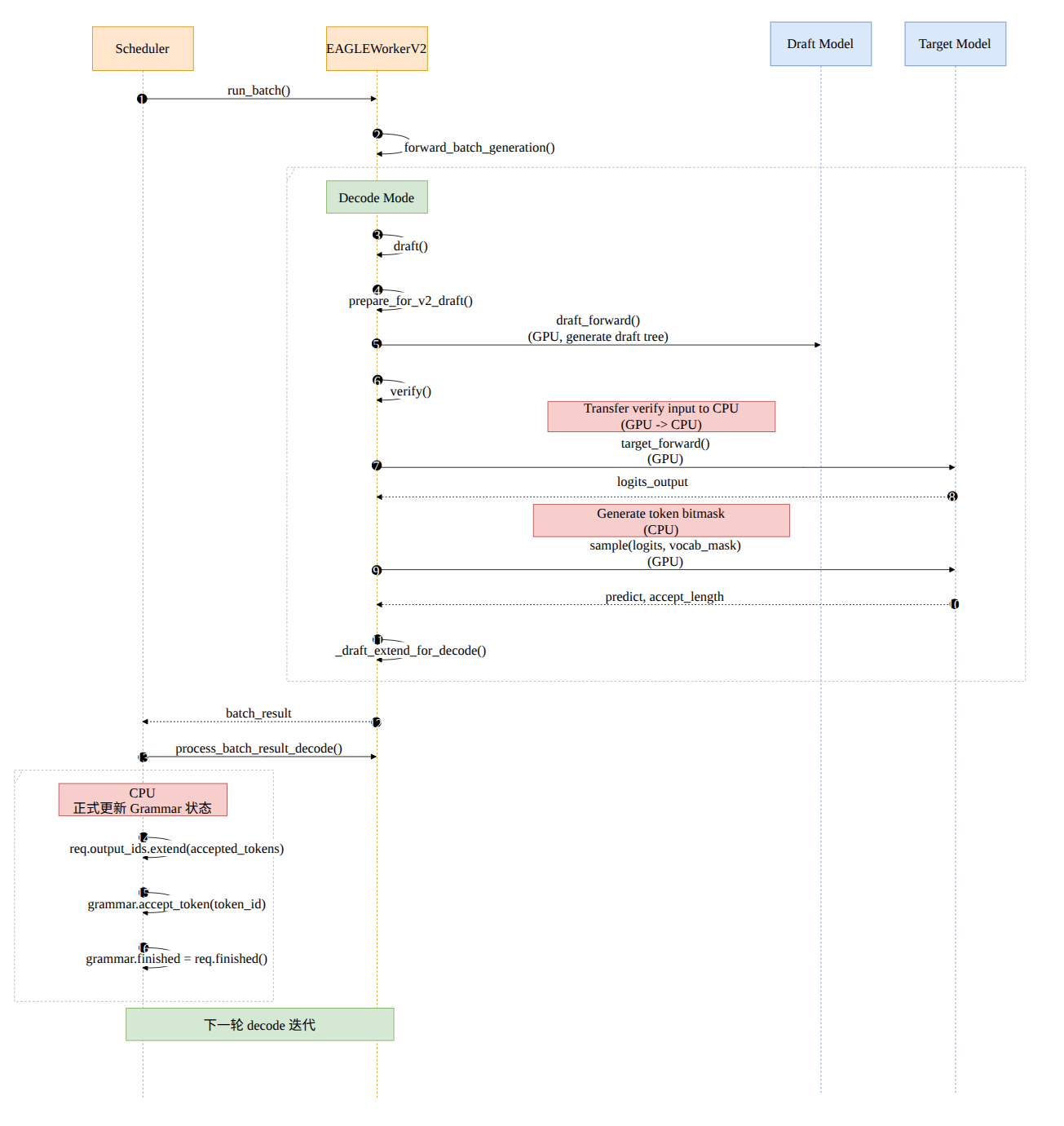
整体流程
Prefill 阶段生成 batch 与不开启 spec 并无不同;通过 self.future_map.resolve_future() 和 self.future_map.store_to_map() 实现异步的结果存取
run_batch() 会先调用 EAGLEWorkerV2::forward_batch_generation()
- target_worker(TpWorker) 执行
forward_batch_generation,采样出第一个 token
Eagle 需要这个 token 对应的 hidden states 进行 draft 的推理
- draft_worker(EAGLEWorkerV2) 执行
_draft_extend_for_prefill - 将 target model 生成的 token 也加入到 batch.input_ids 里面
- 构造 EagleDraftInput,EAGLE v2 的 decode 阶段会基于
verified_id作为树的根节点,再生成 topk 分支并构建 tree mask、positions 等 -
调用 draft model 的 forward_extend() 并进行采样,得到 topk 的 token index & prob 以及 hidden states
-
在 decode 阶段,draft worker 先调用 draft(),再调用 verify(),最后 _draft_extend_for_decode()
-
draft(): 按
speculative_num_steps多步扩展一棵 top-k 树,记录每个节点 token/score/parent,最后从整棵树里挑一批最高分节点作为draft_tokens,并返回树结构信息给build_tree_kernel_efficient,构造出 EageleVerifyInput
> 在 build tree mask 时,会将 verified_id 拼接到 draft tokens 前面作为 root
PythonEagleVerifyInput( draft_token_=draft_tokens, # draft 阶段挑选出来、准备让 target 一次验证的 **候选 token 集合** custom_mask_=tree_mask, # 每个候选节点能看到哪些 token positions_=position, # 每个候选节点对应的 **position id** retrive_index_=retrive_index, # verify batch 中第 i 行,对应 draft 树里的哪个节点 retrive_next_token_=retrive_next_token, # 如果某个节点被接受,下一个应该跳到哪个节点 retrive_next_sibling_=retrive_next_sibling, # 如果当前节点没被接受,下一个备选兄弟节点是谁 retrive_cum_len_=None, spec_steps_=_self_.speculative_num_steps, # draft 扩展的最大深度(树的高度) topk_=_self_.topk, # draft 阶段每个节点的分支数 draft_token_num_=_self_.speculative_num_draft_tokens, capture_hidden_mode_=None, seq_lens_sum_=None, seq_lens_cpu_=None, ) -
verify(): verify 一次 forward,最多验证 spec_steps 个未来 token + 当前 token
- 把 verify 所需的 tree 索引和 token(verify_input) 从 GPU 拷到 CPU,准备更新 vocab mask
> 这里应该用异步拷贝 - Target model 执行
forward_batch_generation(),实际上直接跳过了 sample,只做 forward,得到 logits(every draft token 的概率分布) - CPU 中 grammar 后端生成了 token bitmask
- 对 draft 树做 DFS 构造 vocab mask
- 把 batch.sampling_info.vocab_mask 置空(
None)
- 将 mask 拷贝到 GPU,对 target model 生成的 logits 应用这个 vocab mask
- 对 draft input 做 sample,同时考虑 target 的概率分布和 draft 的 token
!!! tip "Important"
Anyway, 目标模型生成的 bonus token 我们都会接受 - _draft_extend_for_decode():
- 计算的
select_index,只保留最后一个 Token 的预测结果。 - 计算出的
topk_p(概率)、topk_index(Token ID)和 hidden_states 被填入next_draft_input。这个对象会被传递给下一个循环的draft()函数,作为生成新的 Token 树的root(verified_id)
实际上真正的 grammar 更新状态在 scheduler 的 post process 阶段
# Speculative decode: next_token_id 是 accepted tokens 列表
for token_id in next_token_id:
  req.grammar.accept_token(token_id)  ← 正式更新状态
同步点
- Draft Extend N-1 与下一轮调度由 CPU 调度逻辑保证同步
- Write future map 和 Read future map 由 copy_to_cpu() 保证同步
上一轮的 sample 负责 store,这一轮的 run_batch() 进行 get
- Grammar 带来的同步
- 我们为了生成 vocab mask,需要 verify input,需要拷贝 GPU 上的数据,这里用的 .cpu() 实际上是一次同步
-
Sample() 前需要将 vocab mask 应用到 target verify 得到的 logits 上,这里需要将 cpu 的 vocab mask 拷贝到 GPU 上
!!! tip "Important"
这里应该用异步拷贝 -
Draft Extend 更改元数据信息依赖于 verify 的 accept length 和 predict 结果,所以需要同步
由 CPU 侧调度保证

优化 Overlap: speculative decoding + constrained decoding
Motivation
我们实际上有如下依赖关系:
- vocab_mask 生成必须等待 last_batch accept 完成
- vocab_mask 生成必须等待异步拷贝完成
- Sample 必须等待 vocab_mask 到达 GPU
之前的做法是在 Scheduler 的后处理进行 last_batch 的 accept,我们实际上只需要保证 vocab mask 生成前 last_batch accept 即可;同时 target verify 是 GPU 上耗时比较长的任务,我们可以重叠这两个操作,让 GPU overlap CPU 上的计算开销
vocab mask 的生成还依赖 verify input,我们需要一次异步拷贝(GPU->CPU)
sample 需要 vocab mask 应用到 logits 上,也需要一次异步拷贝(CPU->GPU)
Overview
优化后的调度逻辑如下图所示:
-
我们将 GPU 到 CPU 的 verify input 拷贝使用异步拷贝
-
之前的 constraint decoding + speculative decoding 是没有进行调度侧的 overlap 的;这里我们在 GPU 进行 target verify 的同时,处理 last batch 的 accept tokens
-
Target sample 依赖 cpu 生成的 vocab mask,这里使用 .to(device) 进行同步

Implementation
-
ScheduleBatch 中维护一个 (request, accepted_token_ids) 的 list,存放 last batch 还未经过 grammar 处理的 accept_tokens
-
event_loop_overlap 中 current batch 中携带 last batch 的 accept_tokens
last_batch, last_result = self.result_queue[-1]
# here batch is copied, so has_grammar need also as a param
if last_batch.has_grammar:
    batch.last_batch_accept_tokens = (last_batch, last_result)
    # Mark that grammar accept will be processed in the next batch's verify
    last_result.grammar_accept_processed = True
- Verify()
- GPU 到 CPU 的 verify input 的拷贝用异步拷贝
- GPU 进行 Target Verify 的同时,CPU 对上一轮的 grammar accept token 进行处理
- CPU 等待 verify input 拷贝完成后生成本轮的 vocab mask,然后同步到 GPU 上准备进行 Target Sample
JSON Unit Test Result
| 测试场景 | No Overlap(基准) | Overlap(Double Sync) | Overlap(Once Sync) | 最佳策略 |
|---|---|---|---|---|
| JSON Generate(标准长生成) | 0.8557s | 0.7296s(+14.7%) | 0.6687s(+21.8%) | Once Sync |
| JSON OpenAI(短文本 / API) | 0.4455s | 0.2549s(+42.8%) | 0.3861s(+13.3%) | Double Sync |
| Mix Concurrent(混合并发) | 0.6386s | 0.5623s(+11.9%) | 0.5468s(+14.4%) | Once Sync |
# no overlap
[2025-12-23 13:20:02] Test: test_json_generate | Duration: 0.8557s | Status: PASSED
[2025-12-23 13:20:03] Test: test_json_openai | Duration: 0.4455s | Status: PASSED
[2025-12-23 13:20:04] Test: test_mix_json_and_other | Duration: 0.6386s | Status: PASSED
D

# overlap with double sync mask
[2025-12-23 13:20:47] Test: test_json_generate | Duration: 0.7296s | Status: PASSED
[2025-12-23 13:20:47] Test: test_json_openai | Duration: 0.2549s | Status: PASSED
[2025-12-23 13:20:48] Test: test_mix_json_and_other | Duration: 0.5623s | Status: PASSED

# overlap with once sync mask
[2025-12-23 14:18:26] Test: test_json_generate | Duration: 0.6687s | Status: PASSED
[2025-12-23 14:18:27] Test: test_json_openai | Duration: 0.3861s | Status: PASSED
[2025-12-23 14:18:27] Test: test_mix_json_and_other | Duration: 0.5468s | Status: PASSED
Benchmark Result(bs = 4)
Hiding CPU Overhead
- TPOT (Time Per Output Token) 从 4.07ms 降低到了 3.22ms,降幅超过 20%。
Accept Length 提升
- Accept Length 从 2.59 提升到了 2.9。
- 很神奇,正常不应该有 accept length 增长这么多的情况,因为使用相同的模型
首字延迟 (TTFT) 微增
- TTFT 从 21ms 增加到了 27ms。
- Overlap 流水线通常需要更复杂的初始化过程(例如预分配更复杂的 Cuda Event、建立 Pending Info 结构、预热流水线状态)。
- 第一轮 Draft/Verify 往往无法享受到 overlap 的红利(因为没有上一轮),反而承担了额外的调度逻辑开销。
GSM8K Just Eagle2 Test
# No overlap
python3 benchmark/gsm8k/bench_sglang.py --num-shots 8 --num-questions 1319 --parallel 1319
Accuracy: 0.232
Invalid: 0.003
Latency: 44.037 s
Output throughput: 3763.649 token/s

# Overlap
python3 benchmark/gsm8k/bench_sglang.py --num-shots 8 --num-questions 1319 --parallel 1319
Accuracy: 0.230
Invalid: 0.003
Latency: 36.554 s
Output throughput: 4559.657 token/s
Reference
[1]. Clover: Regressive Lightweight Speculative Decoding with Sequential Knowledge
[2]. Fast Inference from Transformers via Speculative Decoding
[4]. Medusa: Simple LLM Inference Acceleration Framework with Multiple Decoding Heads
[5]. EAGLE: Speculative Sampling Requires Rethinking Feature Uncertainty
[6]. EAGLE-2: Faster Inference of Language Models with Dynamic Draft Trees
[7]. EAGLE-3: Scaling up Inference Acceleration of Large Language Models via Training-Time Test